Github Write a Program That Reads a Number in Meters, Converts It to Miles, Feet, Yards
| mile | |
|---|---|
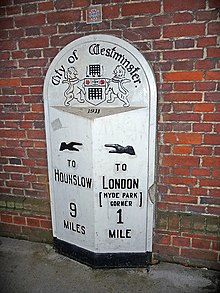 A milestone in Westminster showing the distance from Kensington Road to Hounslow and Hyde Park Corner in miles | |
| General information | |
| Unit system | British imperial/US customary |
| Unit of | length |
| Symbol | mi. or mi or(rarely) m |
| Conversions | |
| i mi. or mi in ... | ... is equal to ... |
| SI units | 1609.344 k |
| regal/United states units |
|
| US survey mile | 0.999998 survey mile |
| nautical units | 0.86898 nmi |
The mile, sometimes the international mile or statute mile to distinguish information technology from other miles, is a British imperial unit and U.s. customary unit of distance; both are based on the older English unit of length equal to five,280 English feet, or one,760 yards. The statute mile was standardised betwixt the British Democracy and the United states past an international agreement in 1959, when information technology was formally redefined with respect to SI units as exactly 1,609.344 metres.
With qualifiers, mile is also used to depict or translate a broad range of units derived from or roughly equivalent to the Roman mile, such as the nautical mile (now 1.852 km exactly), the Italian mile (roughly 1.852 km), and the Chinese mile (at present 500 m exactly). The Romans divided their mile into 5,000 Roman feet but the greater importance of furlongs in Elizabethan-era England meant that the statute mile was made equivalent to 8 furlongs or 5,280 feet in 1593. This form of the mile then spread across the British Empire, some of which continues to employ the mile. The US Geological Survey now employs the metre for official purposes, but legacy data from its 1927 geodetic datum has meant that a carve up US survey mile ( 6336 / 3937 km) continues to run across some use, although it will exist officially phased out in 2022. While most countries replaced the mile with the kilometre when switching to the International Organization of Units (SI), the international mile continues to exist used in some countries, such as Republic of liberia, the United kingdom of great britain and northern ireland, the U.s.a., and a number of countries with fewer than ane 1000000 inhabitants, most of which are United kingdom of great britain and northern ireland or U.s. territories or have shut historical ties with the UK or The states.
Name [edit]
The modern English give-and-take mile derives from Middle English myle and Old English mīl , which was cognate with all other Germanic terms for miles. These derived from the nominal ellipsis form of mīlle passus 'mile' or mīlia passuum 'miles', the Roman mile of one 1000 paces.[1]
The present international mile is commonly what is understood past the unqualified term mile. When this altitude needs to be distinguished from the nautical mile, the international mile may likewise be described as a land mile or statute mile.[2] In British English, statute mile may refer to the present international mile or to whatsoever other form of English language mile since the 1593 Act of Parliament, which set information technology equally a distance of one,760 yards. Nether American constabulary, however, statute mile refers to the U.s. survey mile.[3] Foreign and historical units translated into English as miles usually employ a qualifier to describe the kind of mile beingness used just this may exist omitted if it is obvious from the context, such as a word of the 2d-century Antonine Itinerary describing its distances in terms of miles rather than Roman miles.
The mile has been variously abbreviated in English—with and without a trailing period—equally mi, M, ml, and m.[four] The American National Institute of Standards and Technology at present uses and recommends mi to avert confusion with the SI metre (thousand) and millilitre (ml).[5] Withal, derived units such every bit miles per hr or miles per gallon continue to be abbreviated every bit mph and mpg rather than mi/h and mi/gal. In the United Kingdom, road signs use m as the abbreviation for mile though pinnacle and width restrictions likewise use m as the abbreviation for the metre, which may be displayed alongside anxiety and inches.[6] The BBC way holds that "at that place is no acceptable abbreviation for miles" and and then information technology should be spelled out when used in describing areas.[7]
Historical [edit]

Roman [edit]
The Roman mile ( mille passus , lit. "thousand paces"; abbr. m.p.; likewise milia passuum [northward 1] and mille ) consisted of a thousand paces as measured by every other step—every bit in the total distance of the left foot hit the basis i,000 times. The ancient Romans, marching their armies through uncharted territory, would often button a carved stick in the ground later each 1,000 paces.[ citation needed ] Well-fed and harshly driven Roman legionaries in proficient conditions thus created longer miles. The distance was indirectly standardised past Agrippa's establishment of a standard Roman foot (Agrippa's ain) in 29 BC,[nine] and the definition of a step as v feet. An Royal Roman mile thus denoted 5,000 Roman feet. Surveyors and specialised equipment such as the decempeda and dioptra then spread its apply.[ten]
In modern times, Agrippa's Majestic Roman mile was empirically estimated to have been about one,618 yards (one,479 m) in length, slightly less than the 1,760 yards (ane,610 m) of the modernistic international mile.[11]
In Hellenic areas of the Empire, the Roman mile (Greek: μίλιον , mílion) was used abreast the native Greek units as equivalent to 8 stadia of 600 Greek anxiety. The mílion connected to be used equally a Byzantine unit and was also used every bit the proper name of the zilch mile marker for the Byzantine Empire, the Milion, located at the head of the Mese about Hagia Sophia.
The Roman mile likewise spread throughout Europe, with its local variations giving rise to the different units below.[ commendation needed ]
As well arising from the Roman mile is the milestone. All roads radiated out from the Roman Forum throughout the Empire – fifty,000 (Roman) miles of stone-paved roads. At every mile was placed a shaped stone. Originally these were obelisks made from granite, marble, or whatever local stone was available. On these was carved a Roman numeral, indicating the number of miles from the centre of Rome – the Forum. Hence, one always knew how far one was from Rome.[12]
Italian [edit]
The Italian mile ( miglio , pl. miglia ) was traditionally considered a direct continuation of the Roman mile, equal to g paces,[13] although its actual value over time or betwixt regions could vary greatly.[xiv] It was often used in international contexts from the Middle Ages into the 17th century[xiii] and is thus also known as the "geographical mile",[fifteen] although the geographical mile is now a separate standard unit.
Arabic [edit]
The Arabic mile ( الميل , al-mīl) was not the common Arabic unit of length; instead, Arabs and Persians traditionally used the longer parasang or "Standard arabic league". The Arabic mile was, still, used by medieval geographers and scientists and constituted a kind of precursor to the nautical or geographical mile. Information technology extended the Roman mile to fit an astronomical approximation of 1 arcminute of latitude measured direct northward-and-south along a meridian. Although the precise value of the approximation remains disputed, it was somewhere between 1.eight and 2.0 km.
English [edit]
The "old English mile" of the medieval and early on modernistic periods varied but seems to have measured virtually 1.3 international miles (2.i km).[sixteen] The English language long continued the Roman computations of the mile every bit 5000 feet, 1000 paces, or 8 longer divisions, which they equated with their "furrow'due south length" or furlong.[17]
The origins of English language units are "extremely vague and uncertain",[18] but seem to have been a combination of the Roman system with native British and Germanic systems both derived from multiples of the barleycorn.[n two] Probably by the reign of Edgar in the 10th century, the nominal paradigm physical standard of English length was an arm-length iron bar (a yardstick) held by the rex at Winchester;[nineteen] [21] the foot was so ane-tertiary of its length. Henry I was said to have made a new standard in 1101 based on his own arm.[18] Following the issuance of Magna Carta, the barons of Parliament directed John and his son to keep the king'southward standard measure ( Mensura Domini Regis ) and weight at the Exchequer,[18] which thereafter verified local standards until its abolition in the 19th century. New contumely standards are known to have been synthetic under Henry Vii and Elizabeth I.[22]
Arnold'south c. 1500 Customs of London recorded a mile shorter than previous ones, coming to 0.947 international miles or 1.524 km.[17]
Statute [edit]
The English statute mile was established by a Weights and Measures Human action of Parliament in 1593 during the reign of Queen Elizabeth I. The act on the Limerick of Yards and Perches had shortened the length of the foot and its associated measures, causing the two methods of determining the mile to diverge.[23] Owing to the importance of the surveyor'south rod in deeds and surveying undertaken under Henry VIII,[24] decreasing the length of the rod by 1⁄eleven would have amounted to a pregnant tax increase. Parliament instead opted to maintain the mile of 8 furlongs (which were derived from the rod) and to increase the number of feet per mile from the old Roman value.[25] The applicative passage of the statute reads: "A Mile shall incorporate eight Furlongs, every Furlong twoscore Poles,[north 3] and every Pole shall contain xvi Foot and an one-half."[27] The statute mile therefore contained 5,280 anxiety or 1,760 yards.[17] The distance was not uniformly adopted. Robert Morden had multiple scales on his 17th-century maps which included standing local values: his map of Hampshire, for case, diameter two unlike "miles" with a ratio of i : 1.23 [28] and his map of Dorset had iii scales with a ratio of one : 1.23 : one.41.[29] In both cases, the traditional local units remained longer than the statute mile. The English statute mile was superseded in 1959 by the international mile past international understanding.
Welsh [edit]
The Welsh mile ( milltir or milldir ) was iii miles and 1470 yards long (half dozen.17 km). It comprised 9000 paces ( cam ), each of 3 Welsh feet ( troedfedd ) of 9 inches ( modfeddi ).[30] (The Welsh inch is unremarkably reckoned as equivalent to the English inch.) Along with other Welsh units, it was said to have been codified under Dyfnwal the Bald and Silent and retained unchanged by Hywel the Skillful.[31] Along with other Welsh units, it was discontinued following the conquest of Wales by the English under Edward I in the 13th century.
Scots [edit]

The Scots mile was longer than the English mile,[33] equally mentioned by Robert Burns in the first poetry of his poem "Tam o' Shanter". It comprised viii (Scots) furlongs divided into 320 falls or faws (Scots rods).[34] It varied from place to place but the most accepted equivalencies are one,976 Imperial yards (1.123 statute miles or one.81 km).
Information technology was legally abolished three times: starting time by a 1685 act of the Scottish Parliament,[35] once more by the 1707 Treaty of Union with England,[36] and finally by the Weights and Measures Human action 1824.[33] It had continued in apply as a customary unit through the 18th century just had become obsolete by its final abolition.
Irish [edit]
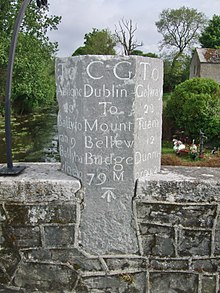
Milestone on Mountbellew Bridge, erected c. 1760. Distances are given in Irish gaelic miles.
The Irish mile ( míle or míle Gaelach ) measured 2240 yards: approximately one.27 statute miles or two.048 kilometres.[37] [38] It was used in Ireland from the 16th century plantations until the 19th century, with residual employ into the 20th century. The units were based on "English measure out" but used a linear perch measuring vii yards (6.four yard) as opposed to the English rod of 5.v yards (5.0 yard).[38]
Dutch [edit]

Scalebar on a 16th-century map fabricated by Mercator. The scalebar is expressed in "Hours walking or common Flemish miles", and includes 3 actual scales: small, medium and big Flemish miles.
The Dutch mile ( mijl ) has had different definitions throughout history. One of the older definitions was 5600 ells. But the length of an ell was not standardised, so that the length of a mile could range between 3280 1000 and 4280 m. The Dutch mile also has had historical definitions of one 60 minutes's walking ( uur gaans ), which meant around five km, or 20,000 Amsterdam or Rhineland feet (respectively 5660 m or 6280 m). Besides the common Dutch mile, there is also the geographical mile. 15 geographical Dutch miles equal one degree of longitude on the equator. Its value changed equally the circumference of the globe was estimated to a improve precision. But at the fourth dimension of usage, information technology was around 7157 m. The metric organization was introduced in the Netherlands in 1816, and the metric mile became a synonym for the kilometre, being exactly 1000 m. Since 1870, the term mijl was replaced by the equivalent kilometer . Today, the word mijl is no longer used, except as function of certain proverbs and chemical compound terms similar mijlenver ("miles away").
German [edit]

Various historic miles and leagues from an 1848 German textbook, given in feet, metres, and fractions of a "degree of top"
The German mile ( Meile ) was 24,000 German language feet. The standardised Austrian mile used in southern Germany and the Austrian Empire was 7.586 km; the Prussian mile used in northern Germany was 7.5325 km. Following its standardisation by Ole Rømer in the late 17th century, the Danish mile ( mil ) was precisely equal to the Prussian mile and as well divided into 24,000 feet.[39] These were sometimes treated as equivalent to 7.v km. Earlier values had varied: the Sjællandske miil , for example, had been 11.thirteen km. The Germans also used a longer version of the geographical mile.
Breslau [edit]
The Breslau mile, used in Breslau, and from 1630 officially in all of Silesia, equal to 11,250 ells, or about 6700 meters. The mile equaled the distance from the Piaskowa Gate all the way to Psie Pole (Hundsfeld). Past rolling a circumvolve with a radius of 5 ells through Piaskowa Isle, Ostrów Tumski and suburban tracts, passing eight bridges on the manner, the standard Breslau mile was determined.[40] [41]
Saxon [edit]
The Saxon post mile ( kursächsische Postmeile or Polizeimeile , introduced on occasion of a survey of the Saxon roads in the 1700s, corresponded to 2000 Dresden rods, equivalent to ix.062 kilometres.[42]
Hungarian [edit]
The Hungarian mile ( mérföld or magyar mérföld ) varied from 8.3790 km to 8.9374 km before existence standardised every bit 8.3536 km.
Portuguese [edit]
The Portuguese mile ( milha ) used in Portugal and Brazil was 2.0873 km prior to metrication.[43]
Russian [edit]
The Russian mile ( миля or русская миля , russkaya milya ) was seven.468 km, divided into 7 versts.
Croation [edit]
The Croatian mile ( hrvatska milja ), first devised by the Jesuit Stjepan Glavač on a 1673 map, is the length of an arc of the equator subtended by 1 / ten ° or 11.13 km exactly.[44] [45] The previous Croatian mile, at present known as the "ban mile" ( banska milja ), had been the Austrian mile given above.[46]
Ottoman [edit]
The Ottoman mile was ane,894.35 m (ane.17709 mi), which was equal to five,000 Ottoman human foot. Later on 1933, the Ottoman mile was replaced with the modern Turkish mile (one,853.181 m).
International [edit]
The international mile is precisely equal to 1.609344 km (or 25146 / 15625 km every bit a fraction).[48] It was established equally office of the 1959 international g and pound agreement reached by the United States, the Britain, Canada, Australia, New Zealand, and the Union of South Africa,[49] which resolved small but measurable differences that had arisen from separate physical standards each land had maintained for the yard.[50] Equally with the earlier statute mile, it continues to comprise 1,760 yards or 5,280 anxiety.
The erstwhile Imperial value of the yard was used in converting measurements to metric values in India in a 1976 Act of the Indian Parliament.[51] Yet, the current National Topographic Database of the Survey of Bharat is based on the metric WGS-84 datum,[52] which is likewise used past the Global Positioning System.
The difference from the previous standards was 2 ppm, or well-nigh 3.2 millimetres ( 1⁄eight inch) per mile. The U.S. standard was slightly longer and the old Imperial standards had been slightly shorter than the international mile. When the international mile was introduced in English-speaking countries, the basic geodetic datum in America was the North American Datum of 1927 (NAD27). This had been constructed past triangulation based on the definition of the foot in the Mendenhall Order of 1893, with one foot = 1200 / 3937 (≈0.304800609601) metres and the definition was retained for data derived from NAD27, just renamed the U.S. survey foot to distinguish information technology from the international foot.[53] [n 4] Thus a survey mile = 1200 / 3937 × 5280 (≈1609.347218694) metres. An international mile = 1609.344 / ( 1200 / 3937 × 5280) (=0.999998) survey miles.
The exact length of the land mile varied slightly among English-speaking countries until the international yard and pound agreement in 1959 established the yard as exactly 0.9144 metres, giving a mile of exactly 1,609.344 metres. The U.Due south. adopted this international mile for nearly purposes, but retained the pre-1959 mile for some country-survey data, terming information technology the U. S. survey mile. In the Usa, statute mile normally refers to the survey mile,[54] about three.219 mm ( 1⁄viii inch) longer than the international mile (the international mile is exactly 0.0002% less than the U.S. survey mile).
While nigh countries abased the mile when switching to the metric system, the international mile continues to be used in some countries, such as Liberia, Myanmar,[55] the United kingdom[56] and the United States.[57] It is also used in a number of territories with less than a million inhabitants, virtually of which are U.K. or U.Southward. territories, or accept close historical ties with the U.K. or U.S.: American Samoa,[58] Bahama islands,[59] Belize,[60] British Virgin Islands,[61] Cayman Islands,[62] Dominica,[62] Falkland Islands,[63] Grenada,[64] Guam,[65] The N. Mariana Islands,[66] Samoa,[67] St. Lucia,[68] St. Vincent & The Grenadines,[69] St. Helena,[70] St. Kitts & Nevis,[71] the Turks & Caicos Islands,[72] and the U.S. Virgin Islands.[73] The mile is fifty-fifty encountered in Canada, though this is predominantly in rail transport and equus caballus racing, as the roadways have been metricated since 1977.[74] [75] [76] [77] The Democracy of Ireland gradually replaced miles with kilometres, including in speed measurements; the process was completed in 2005.
U.S. survey [edit]
The U.South. survey mile is 5,280 U.S. survey feet, both very slightly longer than the international mile and international foot, or about one,609.347 metres and 0.30480061 metres respectively.[78] In the United States, the term statute mile formally refers to the survey mile,[3] merely for most purposes, the difference of less than 1⁄viii inch (3.ii mm) between the survey mile and the international mile (1609.344 metres exactly) is insignificant—one international mile is 0.999998 U.Southward. survey miles—so statute mile can be used for either. But in some cases, such every bit in the U.Due south. State Plane Coordinate Systems (SPCSs), which can stretch over hundreds of miles,[79] the accumulated difference can be significant, and so information technology is important to note that the reference is to the U.Due south. survey mile.
The The states redefined its yard in 1893, and this resulted in U.South. and Purple measures of distance having very slightly unlike lengths.
The N American Datum of 1983 (NAD83), which replaced the NAD27, is divers in metres. Land Plane Coordinate Systems were then updated, just the National Geodetic Survey left individual states to decide which (if any) definition of the foot they would utilise. All State Plane Coordinate Systems are divers in metres, and 42 of the l states only use the metre-based State Plane Coordinate Systems. Yet, eight states also have State Plane Coordinate Systems defined in feet, seven of them in U.S. survey feet and one in international feet.[79]
State legislation in the U.S. is important for determining which conversion factor from the metric datum is to be used for land surveying and real manor transactions, even though the difference (ii ppm) is hardly meaning, given the precision of normal surveying measurements over short distances (unremarkably much less than a mile). Twenty-four states have legislated that surveying measures be based on the U.S. survey foot, 8 have legislated that they be based on the international foot, and eighteen have not specified which conversion gene to use.[79]
SPCS 83 legislation refers to land legislation that has been passed or updated using the newer 1983 NAD information. Nearly states have done then. 2 states (AK, MO) and ii jurisdictions (GU, PR) do not specify which foot to use.[79] Additionally, two states (AL, HI) and iv jurisdictions (DC, Vi, As, MP) practice not have SPCS 83 legislation.[79]
In October 2019, U.S. National Geodetic Survey and National Institute of Standards and Technology announced their joint intent to retire the U.Due south. survey human foot and U.S. survey mile, as permitted by their 1959 conclusion, with consequence from the end of 2022.[80] [81]
Nautical [edit]

On the utility of the nautical mile.
Each circumvolve shown is a great circle—the analogue of a line in spherical trigonometry—and hence the shortest path connecting two points on the globular surface. Meridians are great circles that pass through the poles.
The nautical mile was originally divers as i minute of arc forth a superlative of the Earth.[82] Navigators use dividers to step off the distance between two points on the navigational chart, and so identify the open dividers confronting the minutes-of-latitude scale at the edge of the nautical chart, and read off the altitude in nautical miles.[83] The Earth is not perfectly spherical just an oblate spheroid, so the length of a minute of latitude increases by 1% from the equator to the poles. Using the WGS84 ellipsoid, the commonly accepted World model for many purposes today, ane minute of latitude at the WGS84 equator is 6,046 feet and at the poles is 6,107.5 feet. The boilerplate is nearly half dozen,076 feet (about 1,852 metres or i.15 statute miles).
In the Usa, the nautical mile was defined in the 19th century as 6,080.2 feet (1,853.249 m), whereas in the United Kingdom, the Admiralty nautical mile was divers every bit six,080 feet (1,853.184 m) and was about one minute of latitude in the latitudes of the south of the Britain. Other nations had dissimilar definitions of the nautical mile, but information technology is now internationally divers to be exactly 1,852 metres (half-dozen,076.11548556 feet).[84]
[edit]
The nautical mile per hr is known every bit the knot. Nautical miles and knots are almost universally used for aeronautical and maritime navigation, because of their relationship with degrees and minutes of breadth and the convenience of using the latitude scale on a map for distance measuring.
The information mile is used in radar-related subjects and is equal to half-dozen,000 feet (i.8288 kilometres).[85] The radar mile is a unit of time (in the aforementioned style that the light yr is a unit of distance), equal to the fourth dimension required for a radar pulse to travel a distance of 2 miles (one mile each way). Thus, the radar statute mile is 10.viii μs and the radar nautical mile is 12.4 μs.[86]
Geographical [edit]
The geographical mile is based upon the length of a meridian of latitude. The German geographical mile ( geographische Meile ) was previously 1⁄fifteen ° of latitude (7.4127 km).[87]
Grid organization [edit]
Cities in the continental United States often accept streets laid out by miles. Detroit, Indianapolis, Chicago, Phoenix, Philadelphia, Las Vegas, Los Angeles, and Miami, are several examples. Typically the largest streets are about a mile apart, with others at smaller intervals. In the Manhattan borough of New York Metropolis "streets" are shut to 20 per mile, while the major numbered "avenues" are about six per mile. (Centerline to centerline, 42nd Street to 22nd Street is supposed to be 5250 anxiety while 42nd Street to 62nd Street is supposed to be[ description needed ] 5276 ft eight in.)[ citation needed ]
Metric [edit]
The informal term "metric mile" is used in some countries, in sports such as track and field athletics and speed skating, to denote a distance of one,500 metres (0.932 miles). The 1500 meters is the premier center distance running outcome in Olympic sports. In U.s. high-school competition, the term is sometimes used for a race of one,600 metres (0.994 miles).[88]
[edit]
The Scandinavian mile ( mil ) remains in common employ in Norway and Sweden, where information technology has meant precisely 10 km since metrication in 1889.[39] It is used in breezy situations and in measurements of fuel consumption, which are often given as litres per mil . In formal situations (such as official road signs) and where defoliation may occur with international miles, information technology is avoided in favour of kilometres.
The Swedish mile was standardised as 36,000 Swedish anxiety or 10.687 km in 1649; before that it varied by province from about 6 to 14.485 km.[39]
Before metrication, the Norwegian mile was 11.298 km.
The traditional Finnish peninkulma was translated as mil in Swedish and also set equal to 10 km during metrication in 1887, only is much less commonly used.
Comparing table [edit]
A comparison of the dissimilar lengths for a "mile", in different countries and at unlike times in history, is given in the table below. Leagues are as well included in this listing because, in terms of length, they fall in betwixt the short West European miles and the long North, Central and Eastern European miles.
| Length (m) | Proper name | State used | From | To | Definition | Remarks |
|---|---|---|---|---|---|---|
| 0500 | lǐ | mainland China | 1984 | today | 1500 chi | in Chinese, this unit of measurement and the regal mile are written using the same give-and-take (里), with a qualifier to distinguish between systems if needed |
| 0960–i,152 | Talmudic mil | Land of State of israel/Canaan | Biblical and Talmudic units of measurement | |||
| 0i,480 | mille passus, milliarium | Roman Empire | Ancient Roman units of measurement | |||
| 01,486.6 | miglio[89] | Sicily | ||||
| 0ane,524 | London mile | England | ||||
| 01,609.3426 | (statute) mile | Uk | 1592 | 1959 | 1,760 yards | Over the course of fourth dimension, the length of a yard inverse several times and consequently and so did the English language, and from 1824, the imperial mile. The statute mile was introduced in 1592 during the reign of Queen Elizabeth I |
| 0 1,609.344 | mile | some Anglosaxon countries | 1959 | today | i,760 yards | On 1 July 1959 the royal mile was standardized to an exact length in metres |
| 0 ane,609.3472 | (statute) mile | Usa | 1893 | today | i,760 yards | From 1959 also called the U.S. Survey Mile. From then its only utility has been land survey, earlier it was the standard mile. From 1893 its exact length in metres was: 3600 / 3937 × 1760 |
| 01,820 | Italia | |||||
| 0 ane,852 | nautical mile | international | today | approx. 1 minute of arc | Measured at a circumference of 40,000 km. Abridgement: NM, nm | |
| 01,852.3 | (for comparing) | 1 meridian minute | ||||
| 01,853.181 | nautical mile | Turkey | ||||
| 0ane,855.4 | (for comparison) | 1 equatorial minute | Although the NM was defined on the footing of the minute, it varies from the equatorial minute, considering at that fourth dimension the circumference of the equator could only be estimated at xl,000 km. | |||
| 02,065 | Portugal | |||||
| 02,220 | Gallo-Roman league | Gallo-Roman culture | one.five miles | Under the reign of Emperor Septimius Severus, this replaced the Roman mile equally the official unit of distance in the Gallic and Germanic provinces, although there were regional and temporal variations.[90] | ||
| 02,470 | Sardinia, Piemont | |||||
| 0ii,622 | Scotland | |||||
| 02,880 | Ireland | |||||
| 03,780 | Flemish region | |||||
| 03,898 | French lieue (postal service league) | France | 2,000 "body lengths" | |||
| 03,927 | Ri | Nihon | 12960 shaku | |||
| 04,000 | general or metric league | |||||
| 04,000 | legue | Republic of guatemala | ||||
| 04,190 | legue | Mexico[91] | = 2,500 tresas = 5,000 varas | |||
| 04,444.eight | landleuge | ane⁄25 ° of a circle of longitude | ||||
| 04,452.ii | lieue commune | France | Units of measurement in France before the French Revolution | |||
| 0four,513 | legue | Paraguay | ||||
| 04,513 | legua | Chile,[91] (Republic of guatemala, Haiti) | = 36 cuadros = 5400 varas | |||
| 0iv,808 | Switzerland | |||||
| 04,828 | English language land league | England | 3 miles | |||
| 04,800 0four,900 | Germanic rasta, likewise doppelleuge (double league) | |||||
| 05,000 | légua nova | Portugal[91] | ||||
| 05,196 | legua | Republic of bolivia[91] | = xl ladres | |||
| 05,152 | legua Argentine republic | Argentina, Buenos Aires[91] | = 6,000 varas | |||
| 05,154 | legue | Uruguay | ||||
| 0five,200 | Bolivian legua | Bolivia | ||||
| 05,370 | legue | Venezuela | ||||
| 0v,500 | Portuguese legua | Portugal | ||||
| 0five,510 | legue | Ecuador | ||||
| 0five,510 | Ecuadorian legua | Republic of ecuador | ||||
| 05,532.five | Landleuge (state league) | Prussia | Obsolete German units of measurement | |||
| 05,540 | legue | Honduras | ||||
| 0v,556 | Seeleuge (nautical league) | 1⁄twenty ° of a circle of longitude three nautical miles | ||||
| 0v,570 | legua | Spain and Chile | Spanish customary units | |||
| 0five,572 | legua | Colombia[91] | = 3 Millas | |||
| 05,572.7 | legue | Republic of peru[91] | = twenty,000 feet | |||
| 0five,572.7 | legua Antigua old league | Espana[91] | = iii millas = 15,000 feet | |||
| 05,590 | légua | Brazil[91] | = 5,000 varas = two,500 bracas | |||
| 0v,600 | Brazilian legua | Brazil | ||||
| 05,685 | Fersah (Turkish league) | Ottoman Empire | 1933 | 4 Turkish miles | Derived from Western farsi Parasang. | |
| 0v,840[92] | Dutch mile | Holland | ||||
| 0half dozen,170 | milltir | Wales | 13thC | 9000 camau ( = 27 000 troedfeddi = 243 000 inches) | Eclipsed by the conquest of Wales by Edward I | |
| 0half-dozen,197 | légua antiga | Portugal[91] | = 3 milhas = 24 estadios | |||
| 0half-dozen,240 | Persian legue | Persia | ||||
| 06,277 | Luxembourg | |||||
| 0half dozen,280 | Kingdom of belgium | |||||
| 06,687.24 | legua nueva new league, since 1766 | Spain[91] | = viii,000 varas | |||
| 0six,700 | Breslau mile | Silesia | 1630 | 1872 | Also known every bit Mila wrocławska in Polish | |
| 0vi,797 | Landvermessermeile (state survey mile) | Saxony | Obsolete High german units of measurement | |||
| 0vii,400 | Netherlands | |||||
| 07,409 | (for comparison) | 4 meridian minutes | ||||
| 0seven,419.2 | Kingdom of Hanover | Obsolete German units of measurement | ||||
| 0vii,419.4 | Duchy of Brunswick | Obsolete German language units of measurement | ||||
| 07,420.4 07,414.9 | Bavaria | Obsolete German units of measurement | ||||
| 07,420.439 | geographic mile | 1⁄15 equatorial grads[ dubious ] | ||||
| 07,421.vi | (for comparison) | 4 equatorial minutes | ||||
| 07,448.7 | Württemberg | Obsolete German units of measurement | ||||
| 07,450 | Hohenzollern | Obsolete High german units of measurement | ||||
| 0seven,467.6 | Russia | vii verst | Obsolete Russian units of measurement | |||
| 07,480 | Bohemia | |||||
| 0vii,500 | kleine / neue Postmeile (small/new postal mile) | Saxony | 1840 | German Empire, N German Confederation, K Duchy of Hesse, Russia. Obsolete High german units of measurement. | ||
| 07,532.5 | Land(es)meile (German state mile) | Denmark, Hamburg, Prussia | Primarily for Denmark divers past Ole Rømer. Obsolete High german units of measurement. | |||
| 0seven,585.9 | Postmeile (post mile) | Austro-Hungary | Austrian units of measurement | |||
| 07,850 | Milă | Romania | ||||
| 0eight,534.31 | Mila | Poland | 1819 | 7146 meters before 1819, besides equaled vii verst[93] | ||
| 08,800 | Schleswig-Holstein | Obsolete German units of measurement | ||||
| 0eight,888.89 | Baden | Obsolete German language units of measurement | ||||
| 09,062 | mittlere Mail- / Polizeimeile (heart mail service mile or constabulary mile) | Saxony | 1722 | Obsolete German units of measurement | ||
| 0nine,206.3 | Electorate of Hesse | Obsolete German language units of measurement | ||||
| 09,261.four | (for comparison) | 5 peak minutes | ||||
| 09,277 | (for comparison) | 5 equatorial minutes | ||||
| 09,323 | alte Landmeile (sometime country mile) | Hanover | 1836 | Obsolete High german units of measurement | ||
| 09,347 | alte Landmeile (former state mile) | Hanover | 1836 | Obsolete German units of measurement | ||
| 09,869.6 | Oldenburg | |||||
| 10,000 | metric mile, Scandinavian mile | Kingdom of norway, Sweden | today | even so commonly used today, east. yard. for road distances.; equates to the myriametre | ||
| 10,044 | große Meile (great mile) | Westphalia | Obsolete German language units of measurement | |||
| 10,670 | Republic of finland | |||||
| ten,688.54 | mil | Sweden | 1889 | In normal speech, "mil" means a Scandinavian mile of ten km. | ||
| 11,113.7 | (for comparing) | 6 superlative minutes | ||||
| eleven,132.iv | (for comparison) | half dozen equatorial minutes | ||||
| xi,299 | mil | Norway | was equivalent to 3000 Rhenish rods. |
Similar units:
- 1066.8 m – verst, meet also Obsolete Russian units of measurement
Idioms [edit]
Fifty-fifty in English-speaking countries that accept moved from the Imperial to the metric system (for example, Commonwealth of australia, Canada, and New Zealand), the mile is still used in a variety of idioms. These include:
- A country mile is used colloquially to denote a very long distance.
- "A miss is equally skillful equally a mile" (failure by a narrow margin is no better than any other failure)
- "Give him an inch and he'll take a mile" – a corruption of "Give him an inch and he'll take an ell" [94] [95] (the person in question will go greedy if shown generosity)
- "Missed by a mile" (missed by a broad margin)
- "Become a mile a minute" (movement very speedily)
- "Talk a mile a infinitesimal" (speak at a rapid charge per unit)
- "To go the actress mile" (to put in actress effort)
- "Miles away" (lost in thought, or daydreaming)
- "Milestone" (an upshot indicating significant progress)
See also [edit]
- Biblical mile
- Chinese mile ( 里 )
- Data mile
- Food miles
- Four-minute mile
- Geographical mile
- Medieval weights and measures
- Mile run
- Scandinavian mile
- Section lines
Notes [edit]
- ^ A partitive genitive construction literally meaning "grand of paces".[8]
- ^ The c. 1300 Limerick of Yards and Perches, a statute of uncertain date normally reckoned as an enactment of Edward I[19] or Two,[18] notionally connected to derive English units from 3 barleycorns "dry and round" to the inch[nineteen] and this statute remained in force until the 1824 Weights and Measures Act establishing the Imperial organisation. In do, official measures were verified using the standards at the Exchequer or but ignored.[20]
- ^ "Pole" existence another proper noun for the rod.
- ^ When reading the certificate it helps to conduct in mind that 999,998 = 3,937 × 254.
References [edit]
Citations [edit]
- ^ OED (2002), "mile, n.one ".
- ^ AHD (2006), "mile, 1".
- ^ a b Thompson (2008), B.half-dozen..
- ^ Weintrit, Adam (24 October 2019). "History of the Nautical Mile". Logistyka. Archived from the original on i March 2018. Retrieved 24 Oct 2019.
- ^ Butcher (2014), p. C-16.
- ^ "Road traffic: The traffic signs regulations and general directions 2015" (PDF). Government of the United Kingdom.
- ^ "Numbers" Archived 27 July 2018 at the Wayback Machine BBC
- ^ Lease (1905), p. 211.
- ^ Soren (1999), p. 184.
- ^ Shuttleworth.
- ^ Smith (1875), p. 762.
- ^ Lesley Adkins; Roy A. Adkins; Both Professional person Archaeologists Roy A Adkins (14 May 2014). Handbook to Life in Ancient Rome. Infobase Publishing. pp. 199–. ISBN978-0-8160-7482-2.
- ^ a b ane.
- ^ Zupko (1981), "Miglio".
- ^ 2.
- ^ Andrews (2003), p. 70.
- ^ a b c Klein (1988), p. 69.
- ^ a b c d Chisholm (1864), p. 8. sfnp mistake: no target: CITEREFChisholm1864 (help)
- ^ a b c NPL.
- ^ Chisholm (1864), p. 37. sfnp fault: no target: CITEREFChisholm1864 (help)
- ^ Chisolm (1864), p. 8. sfnp error: no target: CITEREFChisolm1864 (aid)
- ^ Chisholm (1864), p. 4. sfnp error: no target: CITEREFChisholm1864 (help)
- ^ Zupko (1977), pp. 10–11, 20–21.
- ^ Shush (1978), Ch. 9.
- ^ Adams (1990).
- ^ Statutes at large from the first year of Rex Edward the fourth to the end of the reign of Queen Elizabeth. Vol. II. 1763. p. 676. Retrieved 29 Nov 2011.
- ^ Act 35 Eliz. I cap. 6, south. 8.[26]
- ^ Norgate (1998).
- ^ Morden (1695).
- ^ Owen (1841), Book II, Ch. XVII, §5.
- ^ Owen (1841), Book II, Ch. XVII, §2.
- ^ Edinburgh 2000 visitors' guide. Collins. 1999. p. 31. ISBN978-0-004-49017-five.
- ^ a b "mile". Lexicon of the Scottish Language – Scottish National Dictionary.
- ^ "fall, faw". Dictionary of the Scottish Linguistic communication – Dictionary of the Older Scottish Tongue.
- ^ "Act for a standard of miles" (16 June 1685). APS viii: 494, c.59. RPS 1685/4/83.
- ^ Matrimony with England Human action 1707 (c. vii), fine art. 17.
- ^ Rowlett (2005), "Irish gaelic mile". sfnp mistake: no target: CITEREFRowlett2005 (help)
- ^ a b Ordnance Survey Ireland. "Frequently Asked Questions". Archived from the original on 28 Feb 2012. Retrieved 17 February 2009.
- ^ a b c Rowlett (2005), "mil 4". sfnp mistake: no target: CITEREFRowlett2005 (help)
- ^ Encyklopedia Wrocławia. Jan Harasimowicz, Włodzimierz Suleja (Wyd. 1 ed.). Wrocław: Wydawn. Dolnośląskie. 2000. ISBN83-7023-749-5. OCLC 46420892.
{{cite volume}}: CS1 maint: others (link) - ^ Davies, Norman (2002). Mikrokosmos : portret miasta środkowoeuropejskiego : Vratislava, Breslau, Wrocław. Roger Moorhouse, Andrzej Pawelec (Wyd. 1 ed.). Kraków: Wydawn. Znak. ISBN83-240-0172-seven. OCLC 50928641.
- ^ "Historie der Postsäulen" (in High german). Forschungsgruppe Kursächsische Postmeilensäulen e.Five. und 1. Sächsischer Postkutschenverein e.V. Archived from the original on 5 Feb 2017. Retrieved 5 Feb 2017.
- ^ Rowlett (2005), "milha". sfnp error: no target: CITEREFRowlett2005 (help)
- ^ (in Croatian) "Centuries of Natural Science in Republic of croatia : Theory and Application". Kartografija i putopisi.
- ^ Viličić, Marina; Lapaine, Miljenko (2016). "Hrvatska milja na starim kartama" [The Croatian Mile on Erstwhile Maps] (PDF). Kartografija I Geoinformacije (in Croatian and English). Zagreb: Croatian Cartographic Society. 15 (25): iv–22. Retrieved eight July 2019.
- ^ Opačić, Nives (23 Feb 2003). "Mrvice southward banskoga stola". Vijenac (in Croatian). No. 232. Zagreb: Matica hrvatska. Retrieved 8 July 2019.
- ^ "Schedule I, Office VI", Weights & Measures Act of 1985 .
- ^ 1,760 yards × 0.9144 m/yard.[47]
- ^ Barbrow (1976), pp. 16–17, 20.
- ^ Bigg (1964).
- ^ Schedule to the Standards of Weights and Measures Act, 1976.
- ^ Survey of India, "National Map Policy – 2005 Archived 2010-03-31 at the Wayback Motorcar".
- ^ Astin (1959).
- ^ Convert mile [statute] to mile [statute, US] "1 metre is equal to 0.000621 371 192 237 mile [statute], or 0.000621 369 949 495 mile [statute, United states of america]. ... The U.Southward. statute mile (or survey mile) is divers by the survey foot. This is different from the international statute mile, which is defined as exactly 1609.344 metres. The U.Southward. statute mile is defined as five,280 U.S. survey feet, which is around 1609.347219 metres."
- ^ File:Naypyitaw Tollbooth.jpg
- ^ "The Units of Measurement Regulations 1995", legislation.gov.uk, The National Archives, SI 1995/1804
- ^ Maximum posted speed limits Archived 23 September 2011 at the Wayback Machine (Usa) IIHS. Retrieved 14 September 2011
- ^ Hayner, Jeff (29 November 2012). "ASAA planning 1.2-mile swim in Pago Pago harbor". Samoa News. Retrieved xviii January 2014.
- ^ "The Nassau Guardian". 29 August 2012. Archived from the original on 29 October 2013. Retrieved 18 Jan 2014.
- ^ Jerome Williams (thirty August 2013). "Pawpa Brown Race results". Amandala.com.bz. Retrieved eighteen Jan 2014.
- ^ "Mt. bikers compete in Anegada". Bvibeacon.com. 8 May 2013. Retrieved 18 Jan 2014.
- ^ a b "Paddling 300 miles for NCVO". Cayman Compass. 4 June 2013. Archived from the original on 29 Oct 2013. Retrieved xviii January 2014.
- ^ "Statuary medal for Falklands football at Isle Games in Bermuda". Penguin-news.com. 24 July 2013. Archived from the original on 24 September 2015. Retrieved 18 January 2014.
- ^ "Observe the culprit!!!". Spicegrenada.com. Archived from the original on 16 September 2013. Retrieved 18 January 2014.
- ^ "Navy evacuates patient from cruise send 50 miles off Guam". Pacific Daily News. 9 March 2013. Archived from the original on 16 September 2013. Retrieved xviii January 2014.
- ^ IP&E launches Lucky vii Mile Advantage promotion "... through Sept. 9, 2013"
- ^ When you need to get "Dear Editor, I'm deeply concerned about the lack of public toilets effectually the coast ..."
- ^ "The Vox – The national newspaper of St. Lucia since 1885". Thevoiceslu.com. 8 Feb 2008. Archived from the original on 29 October 2013. Retrieved 18 January 2014.
- ^ "Peace Corps Volunteer runs 49 miles from Petit Bordel to Georgetown". Searchlight.vc. 16 December 2011. Archived from the original on 29 October 2013. Retrieved xviii January 2014.
- ^ "And I would walk 50 miles..." Sthelenaonline.org. vii Oct 2012. Archived from the original on 22 March 2014. Retrieved 18 Jan 2014.
- ^ "104 Square Miles, but is it ours?". The St. Kitts-Nevis Observer. 28 September 2012. Archived from the original on 1 Feb 2013. Retrieved xviii January 2014.
- ^ "Provo has a new lodge". Suntci.com. xv July 2009. Retrieved 18 January 2014.
- ^ AARON Greyness (Daily News Staff) (27 February 2012). "Butler outduels archrival to win 8 Tuff Miles". Virgin Islands Daily News. Archived from the original on 16 September 2013. Retrieved eighteen January 2014.
- ^ Weights and Measures Act. Retrieved February 2012, Act current to 18 January 2012. Canadian units (5) The Canadian units of measurement are as gear up out and defined in Schedule Ii, and the symbols and abbreviations therefor are as added pursuant to subparagraph 6(1)(b)(ii).
- ^ Weights and Measures Act Archived 16 October 2012 at the Wayback Machine
- ^ Transportation Prophylactic Lath of Canada Archived 15 July 2012 at the Wayback Auto. Retrieved February 2012, Track Study – 2010 – Written report Number R10E0096. Other Factual Information (See Figure one). two. Assignment 602 travelled approximately 12 car lengths into track VC-64 and at a speed of 9 mph struck a stationary cutting of 46 empty cars (with the air brakes applied) that had been placed in the rails about 2+ 1⁄2 hours before. Canadian railways have not been metricated and therefore continue to measure trackage in miles and speed in miles per hour.
- ^ Hastings Racecourse Fact Book Archived eighteen Apr 2012 at the Wayback Machine Like Canadian railways, Canadian race tracks have not been metricated and proceed to measure altitude in miles, furlongs, and yards (see folio 18 of the fact book).
- ^ "Appendix E. General Tables of Units of Measurement". Retrieved xiv Jan 2020. (links to a Microsoft Give-and-take certificate)
- ^ a b c d e U.S. National Geodetic Survey. "What are the 'official' conversions that are used past NGS to convert 1) metres to inches, and two) metres to feet?". Oft Asked Questions near the National Geodetic Survey. Retrieved xvi May 2009.
- ^ "NGS and NIST to Retire U.S. Survey Foot after 2022". National Geodetic Survey. 31 Oct 2019. Retrieved 4 March 2020.
- ^ "U.S. Survey Foot: Revised Unit Conversion Factors". NIST. 16 October 2019. Retrieved 4 March 2020.
- ^ Maloney (1978), p. 34.
- ^ Maloney (1978), pp. 34–35.
- ^ International Agency of Weights and Measures (2006), The International Arrangement of Units (SI) (PDF) (8th ed.), p. 127, ISBN92-822-2213-half-dozen, archived (PDF) from the original on 4 June 2021, retrieved 16 December 2021 .
- ^ Rowlett (2005), "data mile". sfnp error: no target: CITEREFRowlett2005 (help)
- ^ Rowlett (2005), "radar mile". sfnp error: no target: CITEREFRowlett2005 (help)
- ^ Rowlett (2005), "meile". sfnp mistake: no target: CITEREFRowlett2005 (assist)
- ^ Rowlett (2005), "mile". sfnp error: no target: CITEREFRowlett2005 (help)
- ^ Leopold Carl Bleibtreu: Handbuch der Münz-, Maß- und Gewichtskunde und des Wechsel-Staatspapier-, Banking concern- und Aktienwesens europäischer und außereuropäischer Länder und Städte. Verlag von J. Engelhorn, Stuttgart, 1863, p. 332
- ^ Pre-metric units of length
- ^ a b c d e f g h i j g Helmut Kahnt (1986), BI-Lexikon Alte Maße, Münzen und Gewichte, Leipzig: VEB Bibliographisches Institut, p. 380
- ^ IKAR-Altkartendatenbank [ permanent expressionless link ] der Staatsbibliothek zu Berlin, Kartenabteilung.
- ^ Gloger, Zygmunt (1898). Ksiega rzeczy polskich. Druk W.L. Anczyca i Sp. OL 23442814M.
- ^ Concise Oxford English language Dictionary (5th edition; 1964). Oxford University Press.
- ^ John Heywood (1562). The proverbs, epigrams, and miscellanies of John Heywood ... Print. for subscribers, by the Early on English Drama Social club. pp. 95–. Retrieved 1 December 2011.
Bibliography [edit]
- Adams, Cecil (1990), "What'southward the origin of miles and yards?", The Straight Dope, Chicago, retrieved vi April 2015 .
- The American Heritage Dictionary of the English Language (4 ed.), Boston: Houghton Mifflin Co., 2006 [Originally published 2001], ISBN978-0-618-70172-8 .
- Andrews, J.H. (15 September 2003), "Sir Richard Bingham and the Mapping of Western Ireland" (PDF), Proceedings of the Imperial Irish Academy, vol. 103C, No. iii, Dublin: Royal Irish Academy, archived from the original (PDF) on 17 Feb 2012, retrieved 27 October 2011 .
- Astin, A.V.; et al. (25 June 1959), Doc. 59-5442: Refinement of values for the m and the pound (PDF), Washington, D.C.: National Bureau of Standards .
- Barbrow, Louis E.; et al. (1976), Weights and Measures Standards of the United States—A Brief History (PDF), National Found of Standards and Applied science, doi:10.6028/NBS.SP.447 .
- Bigg, P.H.; et al. (1964), "The U.k. Standards of the Yard in Terms of the Metre", British Journal of Applied Physics, vol. 15, No. 3, pp. 291–300, Bibcode:1964BJAP...xv..291B, doi:10.1088/0508-3443/15/3/308 .
- Shush, James (1978), Connections , Trivial, Brown, & Co., ISBN0-316-11685-8 .
- Butcher, Tina, ed. (2014), "Appendix C", NIST Handbook 44: Specifications, Tolerances, and Other Technical Requirements for Weighing and Measuring Devices .
- Klein, Herbert Arthur (1988) [Originally published 1974], The Science of Measurement: A Historical Survey, New York: Dover Publications (Previously published past Simon & Schuster as The Globe of Measurements: Masterpieces, Mysteries and Muddles of Metrology) .
- Livy (1905), Lease, Emory Bair (ed.), Ab Urbe Condita, vol. I, XXI, & XXII, New York: University Publishing .
- Maloney, Elbert S. (1978), Dutton'south Navigation and Piloting (13 ed.), Annapolis: Naval Institute Press .
- Morden, Robert (1695), Dorsetshire , retrieved 17 August 2011 .
- "History of Length Measurement", Factsheets, Teddington: National Physical Laboratory .
- Norgate, Martin; et al. (1998), "Morden'due south Hampshire 1695", Old Hampshire Mapped, Hampshire County Quango, ISBN1-85975-134-2 , retrieved 17 Baronial 2011 .
- Owen, Aneurin, ed. (1841), "The Venedotian Code", Aboriginal Laws and Institutes of Wales; Comprising Laws Supposed to exist Enacted by Howel the Expert, Modified by Subsequent Regulations under the Native Princes prior to the Conquest by Edward the Kickoff: And Anomalous Laws, Consisting Principally of Institutions which by the Statute of Ruddlan were Admitted to Proceed in Force: With an English language Translation of the Welsh Text, to which are Added A few Latin Transcripts, Containing Digests of the Welsh Laws, Principally of the Dimetian Code, London: Commissioners on the Public Records of the Kingdom . (in Welsh) & (in English)
- Oxford English language Lexicon, 3rd ed. , Oxford: Oxford University Printing, 2002 .
- Rowlett, Russ (2018), How Many? A Dictionary of Units of Measurement, Chapel Loma: University of Due north Carolina, retrieved 5 November 2019 .
- Shuttleworth, M., Building Roman roads, Experiment Resources, archived from the original on 21 April 2011, retrieved ii May 2011 .
- Smith, William, ed. (1875), Dictionary of Greek and Roman Antiquities, London: John Murray .
- Soren, D.; et al. (1999), "A Roman villa and a belatedly Roman babe cemetery : excavation at Poggio Gramignano, Lugnano in Teverina", Bibliotheca Archaeologica, Rome: L'Erma di Bretschneider .
- Thompson, Ambler; et al. (2008), Special Publication 811: Guide for the Employ of the International System of Units (SI) (PDF), Gaithersburg: National Plant of Standards and Technology .
- Zupko, Ronald Edward (1977), British weights & measures: a history from artifact to the seventeenth century, University of Wisconsin Press, ISBN978-0-299-07340-4 , retrieved 26 November 2011 .
- Zupko, Ronald Edward (1981), Italian Weights and Measures from the Middle Ages to the Nineteenth Century, Philadelphia: American Philosophical Order, ISBN0-87169-145-0 .
Further reading [edit]
- NIST Full general Tables of Units of Measurement, United States National Institute of Standards and Technology, archived from the original on 10 December 2011
- "Tafel zur Vergleichung und Bestimmung der Wegemaasse", Naturhistorische und chemischtechnische Notizen nach den neuesten Erfahrungen zur Nutzanwendung für Gewerbe, Fabrikwesen und Landwirthschaft, Expedition der Medicinischen Centralzeitung, 1856, pp. 320–326 (Item notes: Sammlung5-6 (1856–57) Original from Harvard University Digitized 9 January 2008)
- Smits, Jan (xv February 2013) [1996], Mathematical information for bibliographic descriptions of cartographic materials and spatial data, Personal folio on website ICA Commission on Map Projections, archived from the original on 12 February 2014
- Wigglesworth Clarke, Frank (1875), Weights, measures, and money, of all nations, New York, D. Appleton & Company, p. 91
dismukesfeand1945.blogspot.com
Source: https://en.wikipedia.org/wiki/Mile
0 Response to "Github Write a Program That Reads a Number in Meters, Converts It to Miles, Feet, Yards"
Post a Comment